

A pause, only where you asked for one
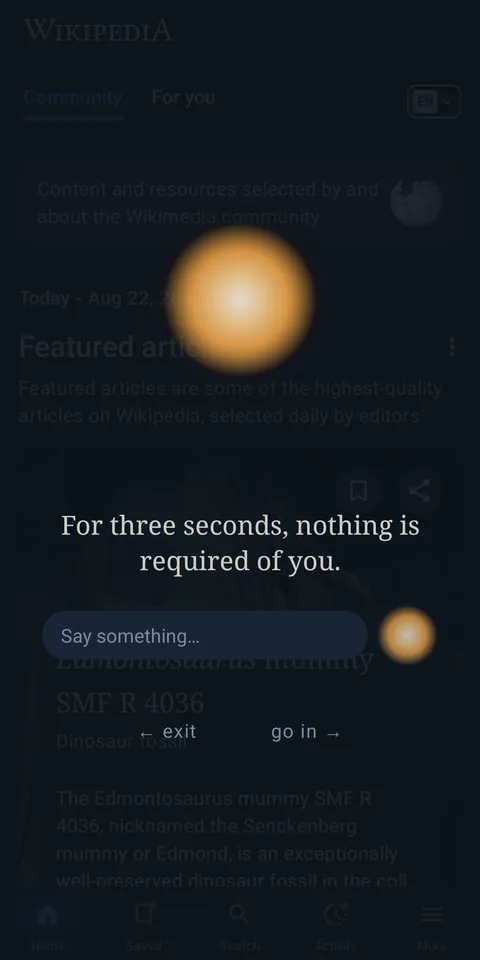
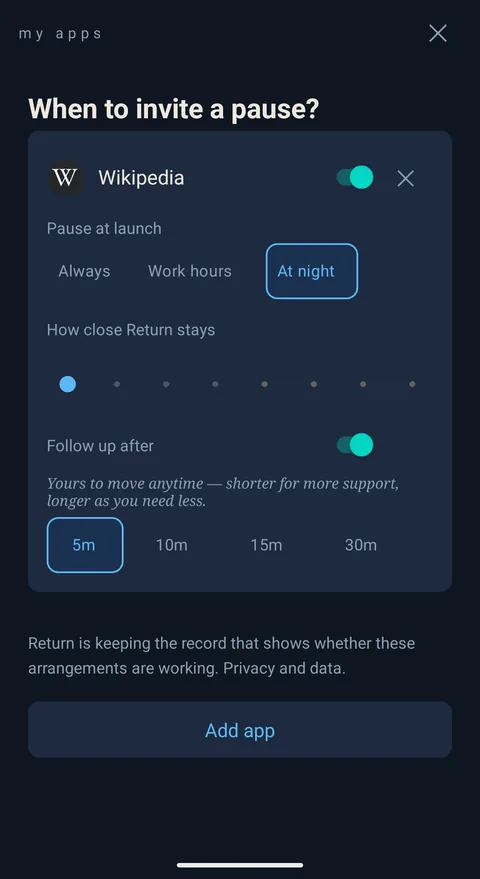
You choose which apps deserve a breath at the door. When you open one, Return meets you there, then you decide.
Built to be needed less
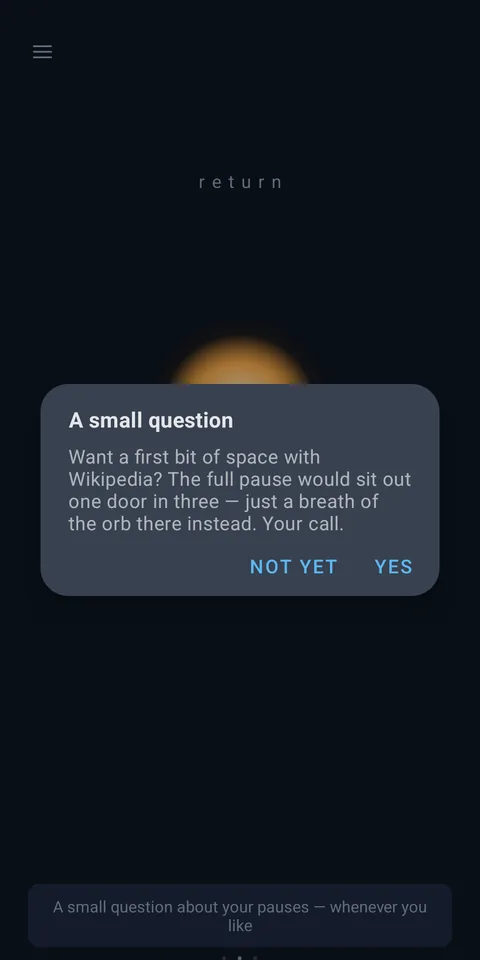
Return offers fewer visits as the pause becomes something you carry yourself. Return includes a real goodbye with a closing reflection on your own journey of returning to You (that reflection needs an AI key).
The pauses themselves grow lighter as they stop being needed, and only ever with your approval: from a full pause at every visit, step by step, down to a standing bow. The bow arrives as a brief breath of light at the door to your chosen apps, yours to hold or to wave through. Return only fades to nothing with your consent. And the last step offers a real closure. Graduation (not retention) is the design goal.
On most days, you’ll be invited to set a daily intention and (if you have an AI key) will receive a weekly reflection on these intentions along with a question for you to reflect on.
The conversation, honestly
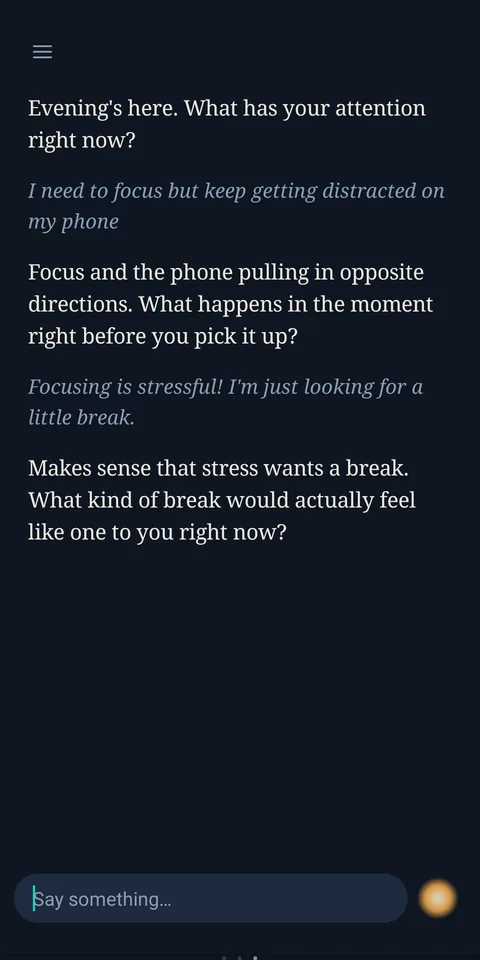
When you want a space to explore your experience, you’ll be met by a carefully shaped version of Anthropic’s Claude Opus designed to elicit self-reflection. It is available to converse with you at any pause or any time within the Return app home. Here is exactly what information is sent to Anthropic.
What is sent when you use a check-in or reflection: that you opened one of the apps you selected (never which app or even what kind of app — only that a pause happened), a rough part of the day, the country the phone is in so (in the case of an emergency) crisis lines match where you are, your first name if you gave one, any intentions you wrote in your own words, and the sleep or evening focus you chose in Settings, if you set one.
What is never sent: the clock time of your visits, how long you spent in an app, your contacts, or anything at all while AI features are off. Return does keep the time you spent in an app you selected in a local timer. It needs this metric to know when to follow up with you (if you choose to receive a follow-up pause). But this data stays on your phone unless you manually send a diagnostic report, which carries a summary of it.
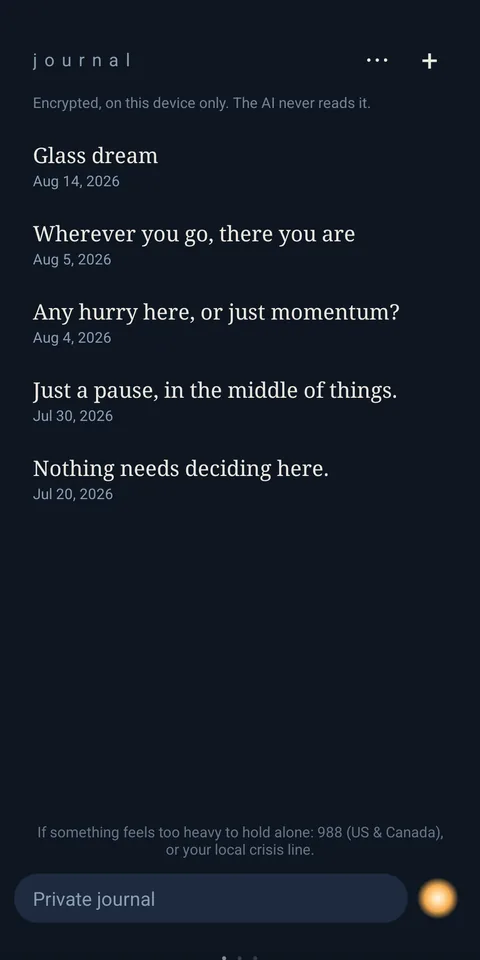
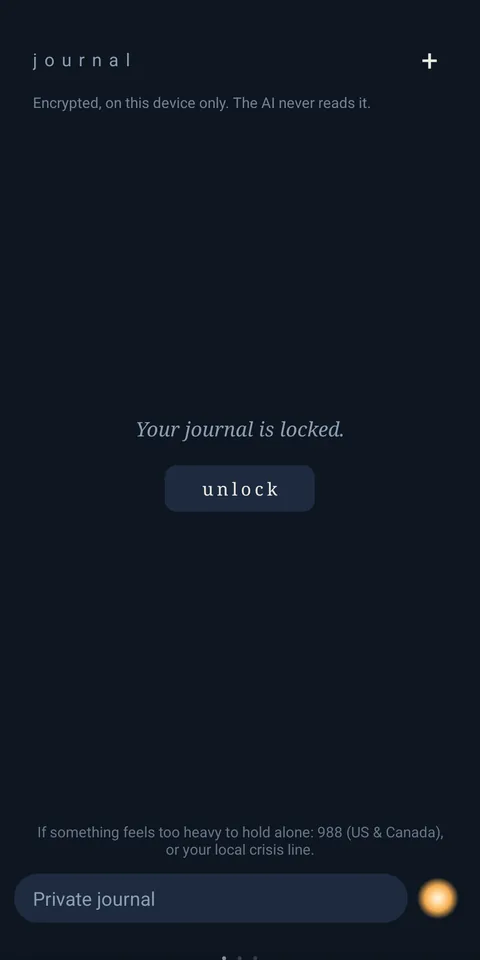
And without a key, it still works. Return holds every pause using a pool of its own written lines that are stored locally. It also offers a private, encrypted journal instead of a chat. In this case, nothing leaves your phone unless you manually send a feedback or diagnostic report. The pool of pause lines is ever growing and you can receive more by allowing a connection to the server, or by waiting for an update. This server connection toggle is off by default, and when it is on the phone only fetches lines: the request carries no identifier and sends nothing about you. You can bring your own Anthropic API key, or use a private invite code; either way, your words are never stored on Return’s servers.
Don't take my word for it
Most wellbeing apps ask you to trust them. Return is built so you don't have to:
- Open source, AGPL-licensed. The complete code publishes with the public release. This includes the server, so even the hosted parts can be inspected.
- A written voice protocol. Every line the AI is allowed to speak is governed by a rulebook that prohibits shaming, urgency, or any attempt to pursue or surveil you. It’s enforced by tests that block an update when a rule breaks.
- A standing safety baseline. The AI’s behaviour in moments suggesting a mental health emergency is red-teamed against a recorded baseline before prompt changes ship, in English and in French.
- An honesty report against my own interests. Return’s aim is to support conscious choice. It’s not another app built to hold you. It runs an internal report asking whether Return itself is becoming a dependency. The report is computed on your phone and you can read it yourself. It is part of the diagnostics shown in full on the feedback screen. It reaches me only if you manually send it.
The short version
- No account. There is nothing to sign up for.
- No ads and no trackers, including on this website.
- Your conversation resets on its own each day.
- Your name, intentions, and journal are encrypted on your device. Turn on the journal lock and it covers itself the moment you leave, and reopens only to your fingerprint or your screen lock.
- Check-in timing stays on your phone unless you manually share it.
What this isn't
Return is a mindfulness tool. It is not therapy, not a mental-health service, and not a substitute for professional support. If you are having a mental health emergency, please reach out to a qualified professional or a crisis service. In the U.S. and Canada you can call or text 988; elsewhere, your local emergency number.
Asked plainly, answered plainly
Why does Return need Usage Access and "display over other apps"?
Usage Access is how Return knows one of your chosen apps just opened. The pause is the whole feature. Display-over-apps is the pause itself: a calm screen at the app’s doorway. Neither is used for anything else, and the app tells you plainly when either is missing.
Does it work without the AI — or offline?
Yes. Without a key, every pause still arrives with Return’s own pool of written lines stored locally, and reflections go to a private encrypted journal instead of a chat. In this mode, nothing leaves your phone unless you manually send it. You have the option to allow the Return server to send more pause lines as the pool grows, but this toggle is off by default until you switch it on yourself.
What does the AI cost?
Return itself is free. The AI conversation runs on your own Anthropic API key (you pay Anthropic directly) or on a private invite code during the beta. What it costs depends on whether you talk: days when you mostly pause and read a line cost a few cents, and days with real back-and-forth conversation have run 10 to 30 cents in my own use. Yours will differ, and you can watch it in your Anthropic console.
Will it nag me, count my hours, or shame me for doom scrolling?
No. Return never counts screen time at you, never says “you’re doing it again!”, and treats going in as a welcome answer. As you learn to pause yourself, Return offers to let the pauses, and then the app, recede.
En français?
Oui — Return speaks Canadian French throughout, crisis resources included. Le site en français →
Try it before the world does
Return is in a small closed beta on Android. Honest reactions — including "this isn't for me" — are the most useful thing you can offer it.